
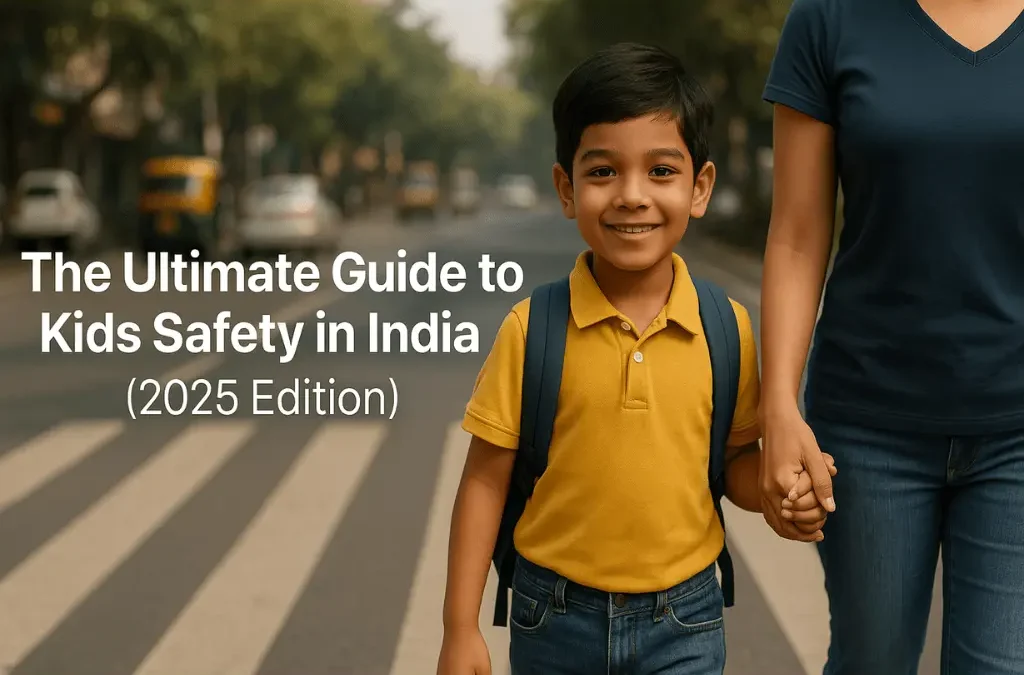
The Ultimate Guide to Kids Safety in India (2025 Edition)
TL;DR (Too Long; Didn’t Read)
- Kids face rising risks – both offline and online.
- NCRB 2022: Over 1.62 lakh crimes against children reported in India.
- Safe Bharat Mission focuses on 4 pillars of child safety: home safety, road safety, school safety, and digital safety.
-
This guide offers real stories, practical tips, and awareness every Indian parent must know.
Every Parent’s Quiet Fear
You know that moment – when your child is late coming home from tuition, and your mind races through a hundred terrible “what ifs.”
That fear? Every parent in India knows it.
We don’t say it out loud, but it sits quietly in the background of our lives.
Our children are growing up in a world very different from the one we did – busier roads, busier schools, busier screens. And while we’re busy earning for their future, their safety in the present has never been more fragile.
This isn’t about paranoia. It’s about preparedness.
Why is Kids’ Safety Becoming a Bigger Concern in India?
In India, children make up nearly one-third of the population. With increasing urbanization, digital exposure, and busy family lifestyles, ensuring kids safety has become a top priority. From unsafe roads to cyber threats, to neglected school protocols the risks have grown more complex. Yet, our safety awareness hasn’t kept pace.
NCRB 2022 recorded:
- 1,62,449 crimes against children.
- 48% related to kidnapping and abduction.
- 1 in 3 children experience bullying or unsafe online behavior by age 13.
These aren’t isolated incidents – they’re warning signs.
And that’s why Safe Bharat Mission started its Kids Safety education – to replace fear with knowledge, panic with preparation.
This Guide provides Indian parents, teachers, and communities with practical strategies, tools, and resources to ensure the safety, security, and well-being of children.
We’ll cover:
- Road safety rules for kids in India
- Online and cyber safety for children
- School safety standards every parent should check
- Best child safety devices and apps in India
Practical tips for home, travel, and play safety
Understanding Kids Safety Challenges in India
Children in India face multi-dimensional safety risks. Parents need to be aware of these challenges to build effective protection strategies.
1 Home Safety Concerns
- Fire and electrical hazards
- Unsafe play spaces
- Stranger interactions in apartments/colonies
2 Road and Traffic Risks
- Poor pedestrian infrastructure in Indian cities
- Lack of awareness of child road safety rules
- High incidence of child road accidents
3 Online Safety and Cyber Protection
- Rising cases of cyberbullying
- Exposure to inappropriate content
- Online scams targeting children
4 School and Institutional Safety
- Inadequate implementation of POCSO Act guidelines
- Unsafe infrastructure (playgrounds, buses, labs)
- Bullying and peer pressure in schools
1. Home Safety: Because Accidents Begin Where We Feel Safest
Home should be the safest place for a child – but for many Indian families, it’s where most accidents happen.
1.1 Fire & Electrical Safety
- Keep matchboxes, lighters, and gas knobs out of reach.
- Install smoke detectors alarm in kitchens.
- Use socket covers to prevent shocks.
- Don’t overload extension boards with gadgets or fairy lights.
- Teach kids what not to touch.
Many families I meet assume “they’re too small to reach there.” They forget how curious little hands are.
1.2 Physical Safety at Home
- Install window and balcony grills if you live in high-rises.
- Use corner guards and door stoppers for toddlers.
- Keep medicines, cleaning liquids, and sharp tools locked.
1.3 Emotional & Mental Safety
- Safety isn’t only about preventing injuries – it’s also about building trust.
- Children who fear their parents won’t tell them when something’s wrong.
- Children who trust their parents – report, confide, and recover faster.
- Talk, listen, and let them know it’s always safe to come to you.
2. Road Safety: The First Lesson Every Child Deserves
Road safety is one of the biggest concerns in India, where traffic accidents remain a leading cause of child injuries. Where most accidents are preventable – caused by careless driving, poor infrastructure, or simple negligence.
2.1 Essential Road Safety Rules for Kids
- Always hold your child’s hand near traffic.
- Always use zebra crossings and pedestrian bridges.
- Avoid running across roads.
- Avoid crossing between parked vehicles.
- Make sure your child knows basic signals – Red means stop, green means go.
2.2 Two-Wheeler Safety
Every day, we see families riding triple-seat without helmets – parents wearing one, children without.
Let’s change that image.
- Children above 4 years must wear child helmets.
- Don’t let kids stand in front of scooters.
- Avoid mobile distractions while riding.
2.3 Car Safety
- Use proper child car seats – not laps.
- Lock rear doors with child safety locks.
- Never leave kids alone in parked cars – heat can rise fatally within minutes.
Small habits. Big protection.
3. Online Safety and Cyber Protection: The New Playground, The New Danger
Today’s children spend more time online than outside. Their playgrounds are digital – and so are the risks. With increasing screen time, online safety has become very crucial for kids protection.
3.1 Dangers of the Digital World
- Cyberbullying and online predators.
- Addiction to gaming and social media.
- Exposure to harmful or adult content.
3.2 How Parents Can Protect Kids Online?
- Teach Digital Awareness Early.
- Explain that not everyone online is who they claim to be.
- Teach kids about online privacy and safe communication.
- Teach kids never to share personal info, photos, or location.
- Encourage open conversations about what they see or hear online.
3.3 Parental Tools & Tech
- Install parental control apps like Google Family Link for age-appropriate browsing.
- Enable Safe Search and Screen Time limits.
- Install cyber safety apps that detect fraud or risky content.
Don’t just say “don’t talk to strangers.”
Explain why?
Show real stories. Talk about online kindness. Teach them that blocking and reporting are not rude – they’re smart.
4. School Safety: And the POCSO Act
Schools are meant to protect, nurture, and educate. But every parent knows – not every school lives up to that promise.
4.1 What Parents Should Check in Schools?
- Is the school fully compliant with fire safety guidelines?
- Are there CCTV cameras in corridors and buses?
- Are there female attendants for girls’ restrooms?
- Are the bus drivers qualified, trained, and safe to drive children?
- Do staff undergo background checks?
- Is the school properly following all POCSO Act guidelines?
4.2 Legal Awareness of Child Rights: Know the POCSO Act
- The POCSO Act (Protection of Children from Sexual Offences Act) ensures child protection against abuse.
- Schools must have Internal Complaint Committees (ICC) and trained staff to handle complaints.
- Schools must have zero tolerance for harassment.
- If your child’s school doesn’t follow this, you have the right to raise it.
5. Travel Safety for Children
5.1 Car Travel
- Always use rear-facing car seats for infants.
- Use booster seats for children up to 12 years.
5.2 Public Transport
- Teach kids not to interact with strangers.
- Ensure school buses follow safety rules.
6. Emotional Safety and Stranger Awareness
Children’s safety isn’t just physical – it’s also emotional.
Bullying, exclusion, and body shaming can scar a child for years.
Teachers and parents must work together to build empathy – not fear.
A simple question like “How was your day?” can open doors to silent stories
- Teach the concept of “safe touch” vs. “unsafe touch.”
- Role-play scenarios to help kids respond to strangers.
- Encourage open conversations without fear.
7. Best Child Safety Devices and Apps in India
Technology is transforming how parents safeguard their children today.
7.1 Popular Child Safety Apps in India
-
Google Family Link – app usage monitoring
-
Life360 – real-time family tracking.
-
Qustodio – screen time control.
7.2 Safety Devices for Kids
- GPS watches with SOS buttons.
- Child-proof safety locks for homes.
- CCTV and home monitoring systems.
8. Government & Community Support for Child Safety
- POCSO Act (2012): Legal framework for child protection.
- National Commission for Protection of Child Rights (NCPCR): Guidelines for schools and parents.
- Helplines: Childline India (1098) – 24×7 emergency support.
Frequently Asked Questions (FAQs)
What are the most important safety rules for children in India?
Always follow road rules, avoid talking to strangers, and use online safely.
Which are the best child safety apps in India?
Google Family Link, Life360, and Qustodio are popular in 2025.
What should parents check in schools for safety?
Fire safety, CCTV, bus driver verification, and POCSO compliance.
How can kids be safe online?
By using parental control apps, safe browsing modes, and cyber safety education.
What is POCSO Act in India?
A legal act protecting children from sexual offences, implemented across schools.
How can I childproof my home in India?
Use socket covers, child locks, smoke detectors, and safe play areas.
Let’s build a Safe Bharat 🇮🇳